As the organization grew in membership and as more unmarried Irish women immigrants entered the United States, it was necessary to form a female branch of the Hibernians. According to historian Hasia Diner, “the Church provided the only formal institution in which women participated on any regular basis,” so forming a female branch of an Irish and Catholic faith based organization made sense.[1] The LAOH began as the “Daughters of Erin” and was first organized in Omaha, Nebraska in 1894 by a group of women who were married to members of AOH. However, the men were wary of granting the “Daughters of Erin” their own charter at the National AOH Convention held in Detroit, Michigan on July 14-17, 1896. In order to calm the fears of the men, a female delegate, a Miss Laughlin stated:
Now, by our presence here, we do not want…to be speechmakers, or political speakers…we are not the “New Woman,” but women who have good Irish mothers who taught them to cook, to sew, to wash, to iron, and to get a good square meal for their husbands. The time, has almost arrived when women and men can stand on equal ground.[2]
While her speech calmed the fear of men about the possibility of Hibernian women becoming suffragists, it also served as a warning that Irish-American women “would no longer be content to remain in the background” according to historian Janet Nolan.[3] The charter members of this new organization notified the public of what the exact purpose of the new female organization was going to be and changed the name of the organization to the Ladies Auxiliary of the Ancient Order of Hibernians in 1906. This act made the LAOH completely independent of the men, although the name of auxiliary suggested otherwise. The Auxiliary part of the LAOH was dropped in the 1980s in order to signify that the women’s branch was truly independent of the male AOH. The LAOH adopted the same motto of “friendship, unity, and Christian charity” as the men, but it remained a completely separate organization from its male counterpart. The LAOH “sought to educate their members in the Catholic culture as well as provide a place where people could come together, enjoy one another’s company, and share their concerns.”[4]
At the National Convention in 1896, delegates debated whether or not wives of AOH members who were not born in Ireland or of Irish descent should be allowed admittance into the LAOH. Father Murphy, chaplain for the Wisconsin AOH said he was:
in favor of the free coinage of Irishmen at any rate; that when persons were
married, they became two in one, although in some cases it is hard to find out which it is; but, when a woman cares enough about an Irishman to marry him he will very likely be the one; heartily in favor of taking them into the order every white woman who was a practical Catholic and married to an Irishman.[5]
This argument eventually won over the men at the convention, and non-Irish women who were married to AOH members were invited to become members of the auxiliary. This is the only account of Hibernian men getting involved in the LAOH. After this debate over membership, the LAOH members were able to keep the men out of the organization’s business.
Allowing American born Irish women and non-Irish wives of Irishmen as members led to an increase in membership for both the AOH and the LAOH. As Irish immigrants moved from the East to the Midwest, they established new divisions of the AOH and the Auxiliary. The AOH came to Ohio in 1850 when the first division of the state was installed in Cincinnati.[6] Divisions sprang up in the urban areas of Youngstown, Cleveland, Toledo, Columbus, Dayton and Akron by the end of the 1870s. Cleveland’s first division was created in 1871. By the end of 1875, four divisions were up and running in the area with membership nearing 400. Toledo installed its first division in July of 1875 with Patrick Garry as the division president. By 1884, “there were 74 divisions in the state, in 27 different counties—the fourth highest number in America and a membership numbering 4,000.” After the 1896 Convention, each male division encouraged their Irish and Irish-American wives to start their own divisions of the LAOH as well. The first charter for the LAOH in Ohio was granted in 1896 to the wives of AOH members in Dayton.[7] By 1910, the Dayton division had over 200 members and “was [one] of the largest auxiliaries in the state.”[8] However, membership in both the AOH and LAOH began to decline with the onset of the 1920s and 1930s. This trend in declining membership in the order can be traced to the high rates of members leaving due to death or old age while not being replenished by the younger generations. By 1941, “there were only 111 Hibernian [members] in divisions left in the entire state.”[9] According to the LAOH state board, the LAOH records reflect this trend as well.[10]
[1] Hasia Diner, Erin’s Daughters in America: Irish Immigrant Women in the Nineteenth Century (Baltimore, MD: The Johns Hopkins University Press, 1983), 127.
[2] Janet Nolan, Ourselves Alone: Women’s Emigration from Ireland, 1885-1920 (Lexington, KY: The University Press of Kentucky, 1989), 85-86. First name of Miss Laughlin is unknown. In the national history of the Ancient Order of Hibernians written by O’Dea, History of the Ancient Order of Hibernians she is referred to as both Miss Laughlin and Sister Laughlin, with no mention of her first name.
[3] Ibid.
[4] Information contained in paragraph was taken from the following source: the Ladies Ancient Order of Hibernians state of Ohio website: http://www.geocities.com/ohiolaoh/ and the quote was taken from the following source: Jay P. Dolan, The American Catholic Experience: A History from Colonial Times to the Present (Garden City, NY: Doubleday & Co, Inc, 1985), 258.
[5] O’Dea, History of the Ancient Order, 1121. Statement is attributed to Murphy according to author John O’Dea who had access to the minutes of the convention when writing the history of the AOH in 1923.
[6] Irish in Cincinnati Events of Importance. Timeline in the hand of Pat Mallory, President of the Hamilton County, Ohio # 1 division, Cincinnati, Ohio. Timeline was obtained through correspondence with Mr. Mallory. Uncatalogued material, Ward M. Canaday Center, University of Toledo, Toledo, Ohio.
[7] Mary Colleen Russell Townsend, Centennial celebration, 1896-1996, November 2, 1996/Ladies Ancient Order of Hibernians, John F. Kennedy Division No.1, Dayton, Ohio (Dayton: Ohio: Ladies Ancient Order of Hibernians John F. Kennedy Division No.1, 1996), 1. Available at Dayton Public Library, Local History Department, Dayton, Ohio. The Dayton No. 1 division of the LAOH is one of the oldest, continually active divisions in the United States. The LAOH in Dayton changed the name of the division to honor President John F. Kennedy upon his assassination in November of 1963. Prior to the 1960s, the division was strictly known as division # 1.
[8] Ibid., 2.
[9] Information contained in the paragraph including the first and third quotes was taken from the following source John T. Ridge, Erin’s Sons in America—The Ancient Order of Hibernians (Brooklyn, NY: AOH Publications, 1986), 93-94.
[10] Ann Dollman, LAOH state board of Ohio Vice President, interview by author, Toledo, Ohio, 14 December 2003, Uncatalogued material, Ward M. Canaday Center, University of Toledo, Toledo Ohio. This trend is also reflected in variety of city directories from the cities of Dayton, Columbus, Cincinnati, Toledo, and Youngstown during the years from the 1920s through the 1970s where there where a lack of divisions actually in existence. This can be compared to the directories of those cities during the 1880s through the 1920 when divisions were listed for several pages for each city.
Saturday, May 26, 2007
Thursday, May 24, 2007
Ladies Ancient Order of Hibernians Part I
The majority of Americans can trace their ancestry back to immigrants who made the decision to leave everything they knew behind, for a chance at better lives in a new and foreign land. Upon their arrival many of these immigrants joined ethnic organizations as an important means of socialization in adapting to their lives in America. These organizations provided mutual assistance for members during times of need, provided a network of information on employment, and gave people a sense of belonging in a strange world where one longed for the comforts of the native homeland. Scholars such as Kerby Miller, Lawrence McCaffrey, and Andrew M. Greeley have written extensively on the Irish-American experience and organizations such as the Ancient Order of Hibernians (AOH) in America. While the majority of the literature focuses on the male perspective of ethnic organizations and immigrant life, it is necessary to give a voice to the female perspective in the area of immigration, an area that is still somewhat overlooked in immigration history.[1]
Hasia Diner and Janet Nolan have written about the experiences of Irish immigrant women in America, but these past efforts focused primarily on a narration of their lives.[2] This study takes an in-depth look at one of the ethnic organizations in which Irish immigrant women took part. The Ladies Ancient Order of Hibernians (LAOH) was one organization that both Irish immigrant and Irish-American women could join. While membership in the LAOH was widespread throughout the United States during the late nineteenth and early twentieth centuries, the Ohio organization stands out as particularly significant. Ohio became the home to many Irish immigrants as they worked their way westward on the canals and railroads. Many Irish settled in the cities of Cleveland, Cincinnati, Toledo, and Youngstown. Divisions of both the AOH and LAOH sprang up in these cities. The state of Ohio had one the largest AOH and LAOH memberships in the nation at the end of the nineteenth and early twentieth centuries and contributed important officers to the organization on the national level.
The LAOH’s scope of activities changed from the early twentieth century to the late twentieth century and this shift in activity can be traced to changing societal roles for women. Most importantly, the activities of the LAOH helped to maintain the link with native Ireland. Members also worked to keep the heritage alive among American-born generations who may not have felt a close connection with their ancestral roots without the organization. The AOH and LAOH “developed in the nineteenth century as… provident association[s] devoted to the advancement of the interests and welfare of Irish immigrants.”[3] In order to understand the history of the LAOH it is necessary to take a look at the history of its male counterpart, the Ancient Order of Hibernians (AOH), its rate of growth in the number of divisions and members, and finally, the activities of the LAOH organization.
The AOH is one of the oldest Irish organizations in the United States. It was founded in 1836 in New York City as a Catholic lay organization for people born in Ireland and later, people born of Irish descent in the United States. The roots of the AOH stretched back to Ireland where the precursor to the American AOH was founded in 1565 to defend Catholic Ireland against Protestant Britain. The American AOH’s motto of “friendship, unity, and Christian charity” was based on that of the older original Ancient Order of Hibernians in Ireland. The AOH was created in New York in response to the rise of nativists’ bigotry against the Irish. The nativist movement was a response to increasing numbers of immigrants, especially the Irish coming into America to flee hunger, disease, and death in Ireland.[4] They feared that increasing numbers of immigrants would harm America economically and felt Catholicism threatened their Protestant nation. Of these three, “anti-Catholicism was the core of nativism from the 1830s through the 1850s.”[5] Many well-known individuals such as Reverend Lyman Beecher and Samuel F. B. Morse “believed in an international conspiracy, engineered by European despots, mainly the Hapsburgs, to use Catholicism as a wedge to destroy American liberal democracy.”[6] After nativists burned down an Ursuline convent in Massachusetts in 1834, “a wave of shootings, hangings, and burnings” were carried out against the Irish immigrants.[7] In order to understand this bigotry and hatred of the Irish, it is necessary to see what was being said about them. Wealthy Protestant George Templeton Strong provides an example of typical rhetoric in a journal entry that described the Irish as “brutal, base, cruel, cowards and as insolent as base; they came from a land populated by creatures that crawl and eat dirt and poison every community they infest.”[8] During the 1850s, a nativist group called the Order of the Star Spangled Banner or Native American party (Know Nothings) became the main nativist group to attack Catholic and especially Irish immigrants.[9] To try and halt the Know Nothings attacks on both Irish people and Church property, the AOH began to “stand guard to defend Church property.”[10
Most early AOH activities remain unknown as the society was founded upon the basis of secrecy. In addition to defending Church property, the organization assisted Irish immigrants financially “who arrived as members in good standing from the Irish Order,” and provided networks which facilitated employment and upward mobility for their members.”[11] The AOH was also instrumental in the “preservation of Irish culture and traditions in America.”[12] As the nativist movement dissipated after the American Civil War, the AOH shifted its focus from defending property to “charitable activities in support of the church’s missions, community service, and the promotion of preservation of their Irish cultural heritage in America.”[13] Organizations such as the AOH did not hinder assimilation into America, but felt “the development of an ethnic identity expressed through a rich institutional and associational life was the primary means through which the American Irish assimilated.”[14] Between the years of 1856 and 1921, over three million Irish immigrated to the United States, increasing membership in the AOH.[15] However controversy over membership in the AOH developed. In 1884, the AOH debated whether or not American born Irish could be admitted as members.[16] Members of the AOH decided that American born Irish could be admitted to the order in addition to those who were born in Ireland.[17] This decision ensured that AOH membership would remain strong after the Irish born members died and that their American born children could carry on the traditions and the work of the AOH.
[1] Andrew M. Greeley, The Irish Americans: The Rise to Money and Power (New York: Harper & Row, 1981), ______, The Most Distressful Nation: The Taming of the American Irish (Chicago: Quadrangle Books, 1972), Lawrence J. McCaffrey, The Irish Catholic Diaspora in America (United States: Catholic University of America Press, 1997), & Kerby A. Miller, Emigrants and Exiles: Ireland and the Irish Exodus to North America (Oxford: Oxford University Press, 1985).
[2] Hasia Diner, Erin’s Daughters in America: Irish Immigrant Women in the Nineteenth Century (Baltimore, MD: Johns Hopkins University Press, 1983) & Janet Nolan, Ourselves Alone: Women’s Emigration from Ireland, 1885-1920 (Lexington, Kent: University Press of Kentucky, 1985).
[3] Reginald Byron, Irish America (Great Britain: Clarendon Press, 1999), 246.
[4] Information contained in paragraph was garnered through a variety of sources such as the national website of the AOH located at http://www.aoh.com/history/main.htm and newspapers from the AOH national newsletter, The National Hibernian Digest. The National Hibernian Digest archives are located at: Balch Institute for Ethnic Studies, Manuscript Collections, Philadelphia, Penn.
[5] McCaffrey, The Irish Catholic Diaspora in America, 99.
[6] Ibid.
[7] Ibid., 100.
[8] Kevin Kenny, The American Irish: A History (London: Pearson Education Limited, 2000), 117-118.
[9] Michael F. Holt, “The Politics of Impatience: The Origins of Know Nothingism” The Journal of American History, Vol.60, No. 2 (September, 1973), 309-331.
[10] Taken from the Ancient Order of Hibernians website history page.
[11] First quote taken from: http://www.aoh.com/history/main.htm and second quote from: Miller, Emigrants and Exiles, 500.
[12] http://www.aoh.com/history/main.htm
[13] Ibid.
[14] Kenny, The American Irish, 148-149.
[15] Miller, Emigrants and Exiles, 346.
[16] Ibid., 535.
[17] John O’Dea, History of the Ancient Order of Hibernians and Ladies Auxiliary, published by the authority of the National Board of the Ancient Order of Hibernians (Philadelphia: Keystone Printing, 1923), 1066-1072.


Monday, May 21, 2007
Book Review
Holden Furber’s John Company at work: a study of European expansion in the late eighteenth century was written in 1948 and examines the rise of the British East India Company during the eighteenth century. Furber begins the book with a description of British controlled India in 1783. His goal in writing the book is “to tell how European expansion took place in India and to describe the consequences of the growth of European power in India at the close of the eighteenth century.”[1] He focuses on the decade between the American and French revolutions, when the “consolidation of European power in India” took place.[2] Furber argues that “by thoroughly understanding what happened during one decade, we can gain a clearer conception of what occurred before and hat came after.”[3
Furber divides his work into nine chapters, each dealing with a different aspect of European expansion in India. After a look at British India during the years of 1783-1785, Furber discusses the rivalry between the English and the French in India. England’s goal according to Furber was to eliminate all competition from India ensuring that they would reign supreme. England’s competition in the form of the Dutch and the French were dependant on them for shipping their trade back to their home countries.
The second half of the book examines the activities of the East India Company at three centers in India: Bombay, Bengal, and Madras. Furber argues that the Company was “robbed and cheated right and left by officials and servants who profited at the expense of the old John Company.”[4] He concludes that “the Company in its corporate capacity was simply a tool used by groups of individuals who cared not a whit what the balance sheet looked like so long as their private ends were served.”[5] In the final chapter Furber discusses that additional studies of English economic activity in India are needed due to the fact that the drain of Indian wealth was offset “ by an increase in wealth among the Indian mercantile community, for which European activity was primarily, though indirectly, responsible.”[6]
Overall, Furber’s work is an excellent analysis of the East India Company during the latter eighteenth century. He used a variety of sources and used the archival records of the East India Company and British colonial administration extensively. Furber’s work just barely touches the history of East India Company, but he gave future historians plenty of unexplored territory to pursue.
[1] Holden Furber, John Company at work: a study of European expansion in the late eighteenth century, (Cambridge: Harvard University Press, 1948), vii.
[2] Ibid.
[3] Ibid.
[4] Ibid., 269.
[5] Ibid.
[6] Ibid., 312.
Wednesday, May 16, 2007
Thoughts on my travel to the Carolinas
While my husband and I were vacationing in the Carolinas last week, I observed many differences between the Carolinas and the Midwest. The first thing that I noticed was the excellent shape that the roads and interstates in the Carolinas were in as compared to the sad shape that many roads and highways in Ohio and Michigan. Another interesting difference was the lottery. All profits from the lotteries in the Carolinas go strictly towards education while the lottery profits here in the Midwest I am not at all too sure of where the money goes. We were very impressed with the cities that we visited and people that we met. The warmest receptions were in Charleston, SC and Wilmington, NC by far. I can't wait to return to the Carolinas. We have even discussed that we would not mind living there in the future if a position at a university or college were to become available. This is a quick post as I have to return to work at my summer job. I will try to write more later.
Monday, May 14, 2007
I'm back
Just a quick post this morning that I am back from getting married and the honeymoon. I will write about our trip to Charleston and Wilmington SC later today.
Thursday, May 3, 2007
Glenn J. Ames, Rensacent Empire? The House of Braganza and the Quest for stability in Portuguese Monsoon Asia, c. 1640-1683
In 2000, Glenn Ames’s work, Renascent Empire? The House of Braganza and the Quest for stability in Portuguese Monsoon Asia, c. 1640-1683 concentrates “on detailing the motivations, underlying assumptions, specific policies, and results of this reformation campaign in Portugese Monsoon Asia” during the years of 1640 to 1683 under the House of Braganza.[1] In addition, “it will also seek to examine the structural limits imposed on this campaign by the internal political, cultural, and economic structures of early modern Portuguese society.”[2] The book is organized into an introduction, seven chapters, and a conclusion; each chapter examines a different aspect of Portuguese Asian history.
The first chapter discusses the consolidation of power of the Portuguese throne under the Braganza dynasty from the Spanish Hapsburgs from Joao IV in 1640 to Pedro’s regency in 1668 when Portugal was recognized as an independent nation in the peace talks with Spain and England at St. Eloi in 1668. Ames states that during this time that the Portuguese “learned to adapt to changing technologies, business practices, administrative reforms, and geo-political and religious realities in the Indian Ocean trade.”[3] Chapter two looks at the politics and policies of Portuguese Asia under the various Viceroys and Governors from 1661 to 1681 in governing Portuguese Asia. The viceroys and governors came from noble families. Ames argues that both sides (the crown and nobility) benefited in the fact that it “…served the needs of an Asian empire badly in need of assistance after long decades of neglect.”[4] Chapter three looks at the role Christianity in Portuguese Asia from 1640 to 1683. This chapter also examines history from below in the fact that it examines the Orphan laws from that time. The fourth chapter is an economic history of Portuguese Asia, especially the impact that the spice trade had on Portugal. In this chapter, Ames demonstrates how Pedro “…was willing to break with centuries-old practices, traditions, and supporters in an effort to salvage what remained of the Estado.”[5] Chapter five focuses on the administration and resiliency of indigenous structures. The sixth chapter looks at how Portugal’s foreign policy maneuvers helped to stabilize Portuguese Asia. The final chapter is a look at how the Portuguese expansion into Mozambique allowed Portuguese Asia to survive.
Ames examined a variety of sources for his work on the Renascent Empire. Archives were consulted in Lisbon, Evora, Panjim, Paris, London, and Bombay in order to tell the story of how the House of Braganza was able to hang onto Asia and make it profitable for Portugal again. Non-archival sources came from a variety of memoirs and other accounts of the period of the Estado. Numerous secondary sources from the experts in European Expansion were consulted such as Boxer, Braudel, Parry, and Prestage.
Overall, the work is an excellent source of information on the House of Braganza and the Estado. A student will find the bibliography to be the most helpful in their perusal of the sources that are available for their research interests in European expansion, especially the Portuguese in Asia. The author did indeed “examine the process by which the Portuguese Crown, in the span of less than two decades, was able to turn the pitiful lamentations of Mello de Castro into the respectful, even envious, descriptions of Aungier and other competitors in the trade.”[6]
[1] Glenn J. Ames, Renascent Empire? The House of Braganza and the Quest for stability in Portuguese Monsoon Asia, c. 1640-1683. (Amsterdam: Amterdam University Press, 2000), 14.
[2] Ibid.
[3] Ibid., 38.
[4] Ibid., 47.
[5] Ibid., 113.
[6] Ibid., 16.
Tuesday, May 1, 2007
Heffer and Nash
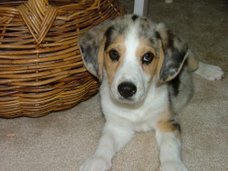
I am a proud "Mom" to my two "kids" Heffer and Nash. Heffer is an 18 month old mutt (Beagle/Australian Shepherd/Australian Cattle Dog) and Nash is a 5 year old Brindle Great Dane. They have two distinct personalities. Heffer is an outgoing, bouncing off the walls, in your face personality. His nose is always getting him into trouble. He doesn't listen very well and is very stubborn. He loves to play fetch, run around, and wrestle with my husband. He also loves to snuggle with me in the mornings before I go off to school. Nash on the other hand reminds me of Eeyore from Winnie the Pooh. My husband got him as a 1 year old pup before I had ever met him. Nash had come from an abused home where he was not allowed to learn how to play. Nash is low key, always looks sad, and does not ask very much from us. We love him all of the time but he does not know how to play, even though we have tried on numerous occasions. What Nash loves most in the world is his sofa. He is happiest when he can lay on his sofa for hours on end.
Both of the dogs love walks, car rides, and trips to the park. They are always doing something funny or crazy. The craziest thing that they did today was when the tornado siren wailed. Instead of following me to the basement, they started howling, barking, and pawing the back door. These two crazy dogs wanted to go outside in the middle of severe weather. It took my husband and me to get them away from the door and down to the basement.
There is never a dull moment with these two kids of mine. I can't imagine life without either of them. They are always there if you need cheering up when you are sad and they are always there whooping it up with you when you're happy. My husband and my two kids give me a family where I am completely free to be myself and loved just for me.
Subscribe to:
Posts (Atom)